Omaha Driveway Sealing Call (402) 787-4097
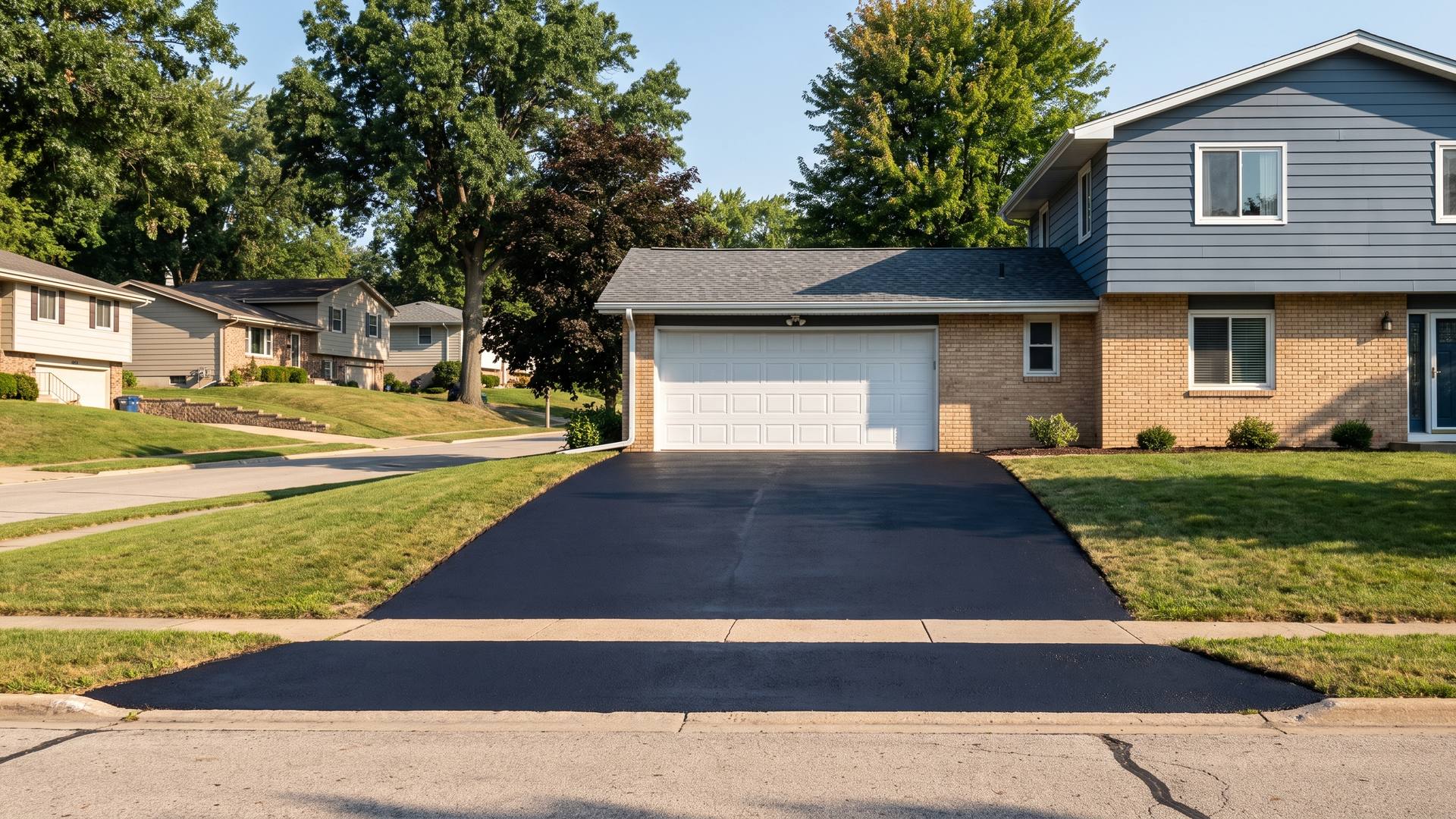
Slate-blue siding over buff brick marks a split-level whose driveway and curb apron shine with new sealcoat on a hilly, tree-lined street

Omaha Driveway Sealing

(402) 787-4097

Free Omaha quotes for driveway sealing and repair.

Omaha Asphalt Sealcoating, Explained From the Ground Up

Pavement at Eppley Airfield drops below freezing and thaws again on about 97 days a year, and the median Omaha home dates from 1973. Here is what that does to asphalt, what sealing costs, and which months work.

  • 96.7 freeze-thaw days a year at Eppley Airfield, NOAA 1991-2020 normals
  • Soils in the city are mostly Monona-Ida loess, per Omaha's stormwater manual
  • Median housing unit built in 1973, Census Bureau ACS 2020-2024 estimates
Loess and weather

Why asphalt wears out the way it does in Omaha

Most of the ground under the city's driveways is windblown silt. The Omaha Regional Stormwater Design Manual says soils within Omaha are predominantly the Monona-Ida association, and both of those soil series formed in loess, the fine dust that wind piled along the Missouri River bluffs during the last ice age. Loess is known for standing in steep banks for years while it stays dry and for losing its cohesion once it is soaked. That habit decides how asphalt ages here: the surface wears from sun and water, while edges and bases fail wherever water gets underneath.

NOAA's 1991-2020 normals for Eppley Airfield, three miles northeast of downtown, count 136.1 days a year with a low at or below 32 degrees and 39.4 days when the high never gets above it. The gap, 96.7 days, is how often pavement freezes overnight and thaws by afternoon. About 51 of those crossings land in December through February and about 21 in the fall. Summer brings the opposite stress: 28 days a year reach 90 degrees, and June through August, a season of relatively frequent thunderstorms, deliver 11.83 inches of rain.

Seal coating answers the surface half of that problem. A thin coat of sealer closes the pores that sun and weather have opened and keeps water, oil and ultraviolet light off the binder that holds the stone together. It does nothing for a base that has already washed out, which is why this site spends as much time on cracks, edges and drainage as on sealer. The housing stock shows why that matters: the median housing unit in the city was built in 1973, and 17.8 percent predate 1940.

This site is an independent guide for property owners in the city, Bellevue, Papillion, La Vista and Council Bluffs. Prices on the cost page are observed ranges from published guides, not quotes, and every weather, soil and housing figure is listed with its source on the pavement data page. Driveway sealing requests sent through the quote form go to independent local contractors, who set their own prices after seeing the pavement.

Free quote

Fields marked * are required.

Fast response during business hours. No obligation.

The work

Sealing, crack filling and repair for Omaha pavement

Big trees shade a driveway curving uphill to a tan brick ranch, its lower bend newly sealed and its upper run cracked gray

Driveway Sealing

Two coats of sealer over a cleaned, crack-filled driveway, applied between late May and September when Omaha nights stay above 50 degrees, to close the surface before another run of freeze-thaw winters.

Typical: $355 - $800 for a two-car drive of about 400 sq ft

White cottonwood fluff drifts across a gray driveway and banks along the grass, a straight band of fresh crack filler running through it

Asphalt Crack Filling

Hot rubberized filler worked into cracks in April or October, when Omaha air temperatures sit between 45 and 65 degrees and cracks are open widest, so water stops reaching the silt base.

Typical: $1 - $3 per linear ft

Beside a low brick retaining wall, a new asphalt patch fills a rectangle in a sloping gray driveway below a buff brick ranch

Pothole and Patch Repair

Cut-out patches and pothole repair for driveways and lots where water has already reached the silt base, with the source of that water dealt with before new asphalt goes in.

Typical: $100 - $500 per pothole; $2 - $5 per sq ft for larger areas

Glass-block windows band a buff brick building facing a lot of jet-black sealcoat and new lines on one side, cracked asphalt on the other

Parking Lot Sealcoating

Sealcoat for commercial, church, school and HOA lots across the metro, done in sections so the lot stays usable, with cracks filled first and restriping after the final coat cures.

Typical: $0.10 - $0.30 per sq ft; published guides run to $0.50

Low sun filters through tall trees onto fresh sealcoat and long white stall lines in a hilltop lot above rolling wooded valleys

Parking Lot Striping

Restriping and new layouts for Omaha-area lots after sealcoating, with accessible stalls counted to the federal minimum and paint applied only once the sealer underneath has fully cured.

Typical: $4 - $5 per stall; $25 - $40 per accessible stall

Bright yellow leaves frame a steep tan brick A-frame church topped by a cross, its lot freshly resealed with new white lines

Asphalt Maintenance Plans

A written schedule for driveways, HOA streets and lots: cracks filled each spring or fall, sealcoat every two to three years, patches before they spread, all timed to the Eppley weather record.

Typical: Per task: crack filling $1 - $3 per linear ft; sealcoat $0.10 - $0.30 per sq ft

Hazy light softens a smooth new asphalt driveway climbing to a buff brick ranch, a red double-drum roller resting on the grass

Asphalt Driveway Paving

New and replacement asphalt driveways built on a compacted base suited to frost-prone loess, with right-of-way rules, one-call notice and the timing of the first seal handled correctly.

Typical: $5 - $15 per sq ft installed; overlays $1 - $4 per sq ft

How this site helps an owner compare Omaha bids

Numbers from Eppley and the city's own manual

The freeze-thaw count, the sealing months and the rainfall figures here come from NOAA's 1991-2020 normals for Omaha Eppley Airfield, station USW00014942, and the soil description comes from the Omaha Regional Stormwater Design Manual and USDA series descriptions. Advice built on 96.7 freeze-thaw days over Monona-Ida silt is advice for this ground, not for pavement in general.

Prices with their sources attached

The cost page lists observed ranges from HomeGuide, Angi, Fixr and the sealer maker SealMaster, and each line names the guide or guides behind it. Those guides disagree by a wide margin, mostly because some quote materials and others quote a finished residential job with labor. The page explains that gap instead of picking whichever number looks friendliest.

Two states, several rulebooks

Council Bluffs sits across the Missouri in Iowa, where excavation needs 48 hours of one-call notice instead of Nebraska's two full business days, and right-of-way permits run through that city's Permits and Inspections Office. Papillion, La Vista and Bellevue each handle driveway approaches their own way. The town pages spell out those differences rather than pretending one rule covers the whole metro.

Independent contractors do the work

This site does not pave, seal or stripe anything. A request sent through the quote form goes to independent local contractors who work in the area, and they price the job after seeing it. Knowing the ranges, the sealing window and the local rules beforehand makes those conversations shorter and the estimates easier to compare line by line.

Job sequence

What a well-run sealing job looks like on loess ground

  1. Read the pavement and follow the water

    A useful walk-through looks at where water goes before anyone talks about sealer. On loess, a gray surface with hairline cracks is a sealing job, but an edge undercut by runoff or a section that flexes under a tire is a base problem. Downspouts that empty onto the driveway and slopes that send water along its edge get noted first, because no coating fixes them.

  2. Clean, fill and prime

    SealMaster's order of work is clear: remove vegetation and debris, fill potholes, clean and fill cracks, then clean oil spots and prime them so sealer will bond. Cracks get hot rubberized filler with a thin band over each side. A thick ridge would catch plow blades, a real concern where Eppley averages 19.9 days a year with a tenth of an inch of snow or more.

  3. Two coats in a dry, warm window

    Sealer goes on in at least two coats, with a third in heavy-traffic lanes. SealMaster rules out any day when rain is forecast within 24 hours or temperatures will fall below 50 degrees within 24 hours. At Eppley the normal low only reaches 50.9 in May and drops back to 41.6 in October, so the dependable season is much shorter than the 172-day frost-free period.

  4. Keep off it, then keep it up

    Foot and vehicle traffic stay off for at least 24 hours, and a two-coat job can need 24 to 48 hours before cars return. After that, SealMaster suggests resealing every two to three years, with crack filling in between. Around Omaha that usually means a crack pass in April or October, when air temperatures sit between 45 and 65 degrees, and sealer in summer.

Ground truth

Soils, freeze-thaw, housing and rules around Omaha

The Monona series, which the manual pairs with Ida, is described by the USDA as very deep, well-drained soil formed in loess on the ridges and side slopes of loess hills, on slopes up to 40 percent. Ida is its steeper, more calcareous partner: calcareous loess on slopes up to 60 percent, with carbonates starting within 10 inches of the surface. Both hold only about 18 to 27 percent clay, so water moves through them readily once it soaks in. That is mostly good news for pavement. The trouble starts when water runs across the surface instead, because silt that drains well also erodes readily, and a driveway edge on a slope is where that shows first.

Silt is also the classic frost-susceptible soil. Frost heave needs three things: freezing temperatures that reach into the ground, a supply of water, and fine-grained soil that draws that water toward the freezing front. Loess supplies the third without argument. Ice lenses grow in it, lift the pavement unevenly and crack it, and that is how the spring pothole season begins. The cold itself is serious at Eppley, with 62.5 nights a year at 20 degrees or lower and 10.7 at zero or below. Median freeze dates bracket the risk: the last 32-degree night of spring comes around April 21 and the first of fall around October 11.

The city's history explains why so many driveways here are old enough to be on a second or third surface. Bemis Park joined in 1887, Dundee, Benson and Florence between 1915 and 1917, Millard in 1971, and Elkhorn after a court fight that ended in 2007. Census Bureau estimates for 2020-2024 put 60.9 percent of the city's 213,023 housing units before 1980, and 16.6 percent in 2000 or later. Growth continues at the edges: Douglas County logged 3,963 building permits in 2025, and Sarpy County to the south grew 9.3 percent between the 2020 census base and mid-2025.

Work that reaches the street is regulated. The city's stormwater program treats any project that disturbs more than 250 square feet of street right-of-way, but less than an acre, as a linear underground project: Public Works must be notified 48 hours before it starts, and storm inlets, tracking and stockpiles have to be protected. Chapter 32 of the Omaha Municipal Code requires an erosion control permit once ground disturbance passes one acre and tells smaller sites to control their sediment anyway. Nebraska law adds a one-call notice at least two full business days before any excavation, which includes digging out a failed base.

Two product rules are worth knowing before anyone opens a bucket. No city, county or state ban on coal-tar sealer applies here: no Nebraska or Iowa jurisdiction appears on the national list of coal-tar bans kept by Coal Tar Free USA, which runs from statewide bans in Washington and Minnesota to Maine and Virginia. The choice between coal tar, asphalt emulsion and acrylic is the owner's. Separately, the city's stormwater program asks residents not to de-ice driveways with salt or sand, since storm inlets carry runoff untreated to the Papillion Creek system and the Missouri and Elkhorn rivers.

Rain arrives hard when it arrives. May is the wettest month at Eppley, averaging 4.76 inches and 7.8 days with a tenth of an inch or more, and the station records 7.2 days a year with an inch or more in a single day. The stormwater manual sizes drainage for 3.0 inches in 24 hours as the two-year storm and 6.7 inches as the 100-year storm, and it gives driveways a runoff curve number of 98, meaning almost nothing soaks in. Hail belongs to the same storm picture: Nebraska logged 315 hail events with stones an inch or larger in 2025, fourth among the states.
Prices

What sealing and repairs cost in the Omaha metro

The ranges below are observed market figures from published cost guides and one sealer manufacturer, gathered for readers in the Omaha metro in September 2026. They are not quotes, and no local contractor supplied them. The guides disagree more than most people expect: SealMaster's contractor figure runs 10 to 30 cents per square foot, yet HomeGuide's full-service driveway number is $1 to $2 per square foot. HomeGuide's own breakdown explains most of the gap, with materials at $0.10 to $0.50 a square foot and labor at $0.90 to $1.50.

Service Typical Omaha Range
Two-car driveway, about 400 sq ft, cleaned and sealed (Fixr, HomeGuide) $355 - $800
Full-service residential sealing, labor included (Fixr, HomeGuide) $0.88 - $2.10 per sq ft
Contractor sealcoat on larger areas and lots (SealMaster) $0.10 - $0.30 per sq ft
Crack filling (Angi, HomeGuide) $1 - $3 per linear ft
Questions

Omaha driveway questions, answered with sources

What does it cost to seal a two-car driveway in Omaha?

Published guides put a typical two-car driveway of about 400 square feet at roughly $355 to $800 to clean and seal. Fixr's repair guide lists $355 to $600, HomeGuide $400 to $800, and Angi's average sits near $470. Crack filling adds $1 to $3 per linear foot. None of these come from a local contractor quote; they are published ranges, and the price table shows which source backs each line.

Which months are workable for sealing in Omaha?

Late May through September is the dependable stretch. Sealer needs temperatures that stay above 50 degrees for a full day after it goes on, and Eppley's normal low passes 50 only in May, at 50.9, then stays above it through September, at 53.9. May is also the rainiest month, with 7.8 days of a tenth of an inch or more, while September averages 5.0, so late summer tends to lose fewer days to weather.

Does loess soil make driveways settle here?

Loess drains well but loses its strength when saturated, which is why it is known in the Loess Hills as sugar clay: hard when dry, without cohesion when wet. Under a driveway that matters wherever water gets in, at open cracks, at edges where runoff cuts along the side, and near downspouts. Kept dry, the Monona-Ida silt under most of the city carries pavement well. The loess guide covers where it fails.

Is coal-tar sealer legal in Omaha and Council Bluffs?

Yes. No Nebraska or Iowa city, county or state appears on the national list of coal-tar sealer bans maintained by Coal Tar Free USA, while states such as Washington, Minnesota, Maine, Virginia and New York restrict it. Coal tar is made up mostly of polycyclic aromatic hydrocarbons, and research links coal-tar sealcoat to PAH levels in streams, so some owners choose asphalt emulsion or acrylic anyway. It is a product choice here, not a legal one.

Why does the city ask residents not to salt their driveways?

The Omaha Stormwater Program lists using salt or sand to de-ice driveways among the things homeowners should avoid, along with letting oil drip from vehicles and washing cars on pavement. The reason is where the water goes: storm inlets carry runoff untreated into the Papillion Creek system and the Missouri and Elkhorn rivers. Asked what may go down a storm drain, the program's FAQ is blunt: never put anything down a storm inlet.

How many freeze-thaw cycles does pavement get in a year here?

About 96.7 days a year at Eppley Airfield see the temperature fall to 32 or below and climb back above it. That is NOAA's 136.1 days with a low at or below freezing minus the 39.4 days when the high stays at or below freezing. December through February account for about 50.8 of those days and September through November about 21.3. The data page shows the full table.

Do Council Bluffs jobs follow the same rules as Omaha jobs?

No. Council Bluffs is in Iowa, so a contractor digging out a base there gives the one-call center 48 hours of notice under Iowa Code 480.4, rather than Nebraska's two full business days. Right-of-way permits for driveway, sidewalk, sewer and excavation work go through the Council Bluffs Permits and Inspections Office. Weather is effectively shared, since Eppley Airfield sits on the Missouri River floodplain three miles northeast of downtown Omaha.

Is sealing worth it on a driveway that is already cracked?

Often, if the cracks are separate lines and the base is firm. Cracks get cleaned and filled first, then the sealer goes over the whole surface; SealMaster's application order puts crack filling before any coat. If cracks have joined into a web across most of the driveway, HomeGuide's rule of thumb points to replacement once cracks cover 60 percent or more of the surface, and sealer only delays that decision.

How often should a driveway in this climate be resealed?

SealMaster recommends sealing about every two to three years and notes that harsh winters, freeze-thaw cycles and snow plowing wear sealer faster. With 96.7 freeze-thaw days and 26.4 inches of normal snowfall at Eppley, driveways here sit toward the shorter end of that range, particularly those cleared with a plow blade. Filling cracks between sealing years matters as much as the sealer itself.

Is a permit needed to repave or widen a driveway in the metro?

It depends on the city and the scope. In Omaha, work disturbing more than 250 square feet of street right-of-way falls under the stormwater program's rules, with 48 hours' notice to Public Works. Papillion requires a Drive/Patio permit with a site plan, La Vista requires a permit whenever any part of the approach is replaced, and Bellevue exempts replacement of a driveway no larger than the old one.

Coverage

Omaha neighborhoods and river towns covered

Dundee Benson Florence Millard Elkhorn Aksarben Field Club Keystone Regency Miller Park Bemis Park Ralston Boys Town Gretna Bellevue Papillion La Vista Council Bluffs

Ask independent Omaha contractors for a price

Describe the driveway or lot, its size and what is wrong with it. The request goes to independent local contractors who work in Omaha and nearby towns.

Free quote

Fields marked * are required.

Fast response during business hours. No obligation.